Saturday, April 20, 2013

#11 Duncan McArthur


Duncan McArthur

Born: June 14, 1772
Died: April 29, 1839
Political Party: Federalist / National Republican
Term of Office: December 18, 1830 - December 7, 1832
Buried: Grandview Cemetery Chillicothe, Ohio
No. 27 of 56 

    Duncan McArthur was born in New York State in 1772 to a poor farming family. His family moved to western Pennsylvania when he was still very young. He was the oldest of 11 children. Life on the frontier was tough and while growing up, McArthur never had a formal education, since he was needed to work most of the time. 

   In 1790, McArthur joined the Pennsylvania Volunteers. Before long he was in the Northwest Territories fighting Native Americans. In the military he earned recognition for bravery and good leadership. 

    In 1793, he joined a surveying expedition of the Northwest Territories led by Nathaniel Massie. Three years later, he joined Massie again on another surveying job. This time laying out the new town of Chillicothe, Ohio. McArthur likes the area so much that he acquired some land in the area. He found a way to make a lot of money on land speculation in the Northwest Territory. So he built a really nice house on the land that he had gotten in Chillicothe and called it "Fruit Hill". McArthur earned a reputation for his hospitality at Fruit Hill. Chillicothe became the first Capital of Ohio when it obtained statehood in 1803. 

    McArthur first entered politics in 1805 when he was elected to the Ohio State Senate. Then in 1809, he became Speaker of the State Senate. In this position he supported moving the State Capital in Columbus. 

    When the War of 1812 broke out, McArthur had joined the state militia and was quickly promoted to Major General. McArthur served as second in command to General William Hull in the state militia at Fort Detriot. He was captured by the British near Detroit when Hull surrendered to British forces. After being paroled he joined the U.S. Army and became a Brigadier General under the command of future President and General William Henry Harrison. Shortly after the fall of Shawnee Chief Tecumseh in 1814, Harrison resigned, leaving McArthur in command of the army in the Northwest. 

   After the war, McArthur was elected to the Ohio House of Representatives 1815, where he managed a few treaties with American Indian tribes. He lost reelection to a 3rd term in the Ohio House in 1819. However, throughout the 1820's he would serve in a number of elected offices. From 1821-1823 he served in the State Senate again. Then from 1823-1825 he served in the U.S. House of Representatives. After losing reelection in 1825, he served in the Ohio House of Representatives from 1826-1827 and again from 1829-1830. 

   McArthur ran for Governor in 1830, beating future Governor Robert Lucas. As Governor, the Ohio and Erie Canal was completed. Also the National road made it as far a Zanesville. Other then that he served one uneventful term as Ohio's Governor and did not seek re election.

He retired to his Fruit Hill home in Chillicothe, Ohio. After he died in 1839, his son in law, Future Governor William Allen inherited his home.


McArthurs Fruit Hill home. Since I couldn't find any recent pictures I am guessing the house no longer exist.


McArthurs gravesite


McArthur Allen Gravesite

My little Nicky explores the McArthur gravesite


Governor McArthur and I


#31 William Allen

William Allen

Born: December 1803
Died: July 11, 1879
Political Party: Democrat
Term of Office: January 12, 1874 - January 10, 1876
Buried: Grandview Cemetery Chillicothe, Ohio
No. 26 of 56


    William Allen was born in North Carolina in 1803. He was orphaned at a very young age and was taken in by his half sister and her husband Reverend Pleasant Thurman. He moved to Chillicothe, Ohio in 1819 to be close to his sister's family. After 3 years of studying law, he was admitted to the Ohio bar at the age of 21. As a lawyer he gained a reputation for his speaking a debating skills.

   In 1832, William Allen became the Democratic parties candidate for a seat in the U.S. House of Representatives. His opponent was outgoing Governor of Ohio Duncan McArthur. Allen beat McArthur in a tight race. Allen eventually married McArthur's daughter. After 1-2 year term in congress, Allen lost reelection and returned to his law practice in Chillicothe.

   In 1837, Allen was chosen to be a U.S. Senator. He served 2- 6 year terms in the Senate before losing reelection to a 3rd term in 1849. In the Senate, Allen became an ally of President James K. Polk and his western expansion efforts. Some credit him for coining the term "Fifty fore forty for fight". This was the slogan for people who wanted to annex the entire Oregon Territory. And the northern border of the Oregon Territory was the 54 degrees 40 minutes latitude line.

   At the 1848 Democratic national convention, the front runners for the Presidential nomination were former President Martin Van Buren and former Secretary of War Lewis Cass. Many encouraged Allen to run as a compromise candidate, but he refused. Instead he put his support behind Cass, who then secured the nomination, but lost in the general election to Zachary Taylor. After his second term as Senator was over, Allen returned to his "Fruit Hill" farm that he had inherited from his father in law Duncan McArthur, seemingly retired from politics.


     By 1873, the corruption of the Grant administration left a good possibility for a Democrat to win the Ohio Governorship.  William Allen's nephew (sister's son), then U. S. Senator Allen G. Thurman suggested that his Uncle become the nominee. Allen won the election against incumbent Governor Edward M. Noyes. He was a strong Governor, cutting taxes and at times settling labor disputes by calling in the state militia. Ultimately, it was his support of green back (money with no gold or silver backing it) that lost him public support. He lost his re election in 1875 to former Governor and future President Rutherford B. Hayes.

    His nephew Allen Thurman would become President Grover Cleveland's VP running mate in his failed re election bid in 1888.

  Allen died at his Fruit Hill home in Chillicothe in 1879. 

  After picking up a couple Ohio Governors buried out of state on one of my President sites trips in March 2012, I didn't get around to gravehunting for Ohio Governors for several months. Finally an opportunity presented itself in October 2012 when my sister in law, who lives in southern Ohio was having a baby shower. She lives about an hour away from Chillicothe. So I dropped off my wife and daughter Khloe at the shower, while my son Nicky and I headed to Chillicothe. It was a beautiful fall day at the peak of fall foliage. In Chillicothe is Grandview Cemetery final resting place of 4 of Ohio's earlier Governors. Of the 4, 2 are brother in laws (Edward Tiffin and Thomas Worthington) and 2 are father - son in laws (Duncan McArthur and William Allen).

    Now I already knew the Tiffin - Worthington connection, but did not know that McArthur and Allen were in laws. But when I finally stumbled upon Allens grave, and immediately found McArthur right next to him. I figured there had to be some sort of family connection. In Cincinnati's Spring Grove Cemetery, there are a couple of Governors who happen to be 20 or 30 feet away from each other. These 2 have them beat considering that their individual headstones are less then 5 ft. apart.


Fruit Hill in Chillicothe, Ohio was William Allens home that he inherited from his father in law Duncan McArthur


Governor Allen


Notice the close proximity between Governor Allen on the left and Governor McArthur on the right. The flag markes McArthurs individual gravesite and 2 small stones over in Allen.


Governor Allen and me

Friday, April 19, 2013

#5 Othniel Looker

Othniel Looker


Born: October 4, 1757
Died: July 23, 1845
Political Party: Democratic Republican
Term of Office: March 24, 1814 - December 8, 1814
Buried: Kitchell Cemetery Palestine, IL
No. 25 of 56

   Othniel Looker was born on Long Island, New York. In 1776 he joined the New Jersey Militia where he served as a private during the Revolutionary War. He would serve in the New York State Assembly. Like many Revolutionary War veterans, Othniel Looker was given land in Ohio by the federal government. After moving to Hamilton County, Ohio he was elected the Ohio House of Representatives, where he served from 1807 to 1809. Then he served in the Ohio Senate from 1810-1812 and 1813-1817.

  After Governor Return J. Meigs Jr. was appointed Postmaster General in 1814, then Speaker of the Ohio Senate Othniel Looker assumed the Governorship. He finished out Meigs term, but was defeated in his attempt to gain a term on his own right by the much more well known Thomas Worthington.

    After returning home to Hamilton County in 1817, Looker served as an associate judge on the Court of Common Pleas in Hamilton County. 

   After his wife died, he left Ohio and moved to Palestine, IL to live with his daughter. It was in Palestine that he died and was buried in 1845. Becoming one of seven Ohio Governors, who are not buried in Ohio. He was also the only Governor of Ohio to serve in the American Revolution.

   I visited the gravesite of Othniel Looker in March 2012, on my way home from St. Louis. It was interesting to find. His grave is in a small cemetery that only consist of a few head stones and is right smack dab in the middle of a residential neighborhood. I made the stop quick, because it seemed possible that it was private property, considering the headstone is literally a few feet from someones house.

There is also an Othniel Looker House near Cincinnati that I hope to see someday. And add to this page.


The small cemetery in which Governor Looker is buried. Kitchell was the last name of his son in law, whom he was living with


The small Kitchell Cemetery

Gravesite of Governor Looker


A close up. There was once a picture in the rectangled area between Born and Died.


Governor Looker and I

Thursday, September 27, 2012

#27 Charles Anderson

Charles Anderson

Born: June 1, 1814
Died: September 2, 1895
Political Party: Whig / Republican
Term of Office: August 29, 1865 - January 8, 1866
Buried: Kuttawa Cemetery Kuttawa, Kentucky
No. 24 of 56


    Charles Anderson was born near Louisville, Kentucky in 1814 into a prominent family. His father had served as an aide-de-camp to the Marquis de Lafayette during the American Revolution. He attended Miami University where he graduated in 1833. After graduation he moved back to Louisville to study law. Then in 1835, he moved to Dayton, Ohio and got admitted to the Ohio bar. He set up his own law practice, while also running his family farm. As he gained a name for himself in the Dayton area as a successful lawyer, he was elected to be Montgomery Counties prosecuting attorney. 

   In 1844, he was elected to a seat in the Ohio Senate. As a member of the Whig party, he strongly opposed Ohio's black laws, which limited rights to African Americans. After being involved in the construction of the new statehouse he returned to his law practice and farm in Dayton after just one term in state government. In 1848, Anderson moved to Cincinnati to start a new law practice partnership. Business was going well, but due to health problems he moved back to Dayton around 1855. In 1859, Anderson moved to a farm he bought near San Antonio, Texas, hoping that the new climate would improve his health. 

    When the Civil War broke out, Anderson's pro union position was very unpopular with his southern neighbors. Fearing for his families safety, he fled for Mexico. He was arrested en route to Mexico and thrown in a San Antonio jail for awhile. But he eventually made his escape to Mexico was then allowed to return to Dayton, Ohio.

   President Lincoln sent him on a Pro Union speaking tour of Europe. After that he served as a Colonel in the Union Army until he was badly injured. He resigned from the military and returned home to Dayton, fully expecting to die from his injuries. But after a slow recovery, he decided to enter politics again. In 1863 he ran for Lt. Governor of Ohio on a pro Union ticket with John Brough. The Union party ticket won the election.

 On August 29, 1865 he assumed the Governorship upon the death of Governor John Brough. Since the Civil War was over, Anderson's few months as a place holding Governor were uneventful. Anderson chose not to seek a term of his own. After his brief time as Governor he returned to Kentucky, where he was born, to practice law. He died in Kentucky in 1895

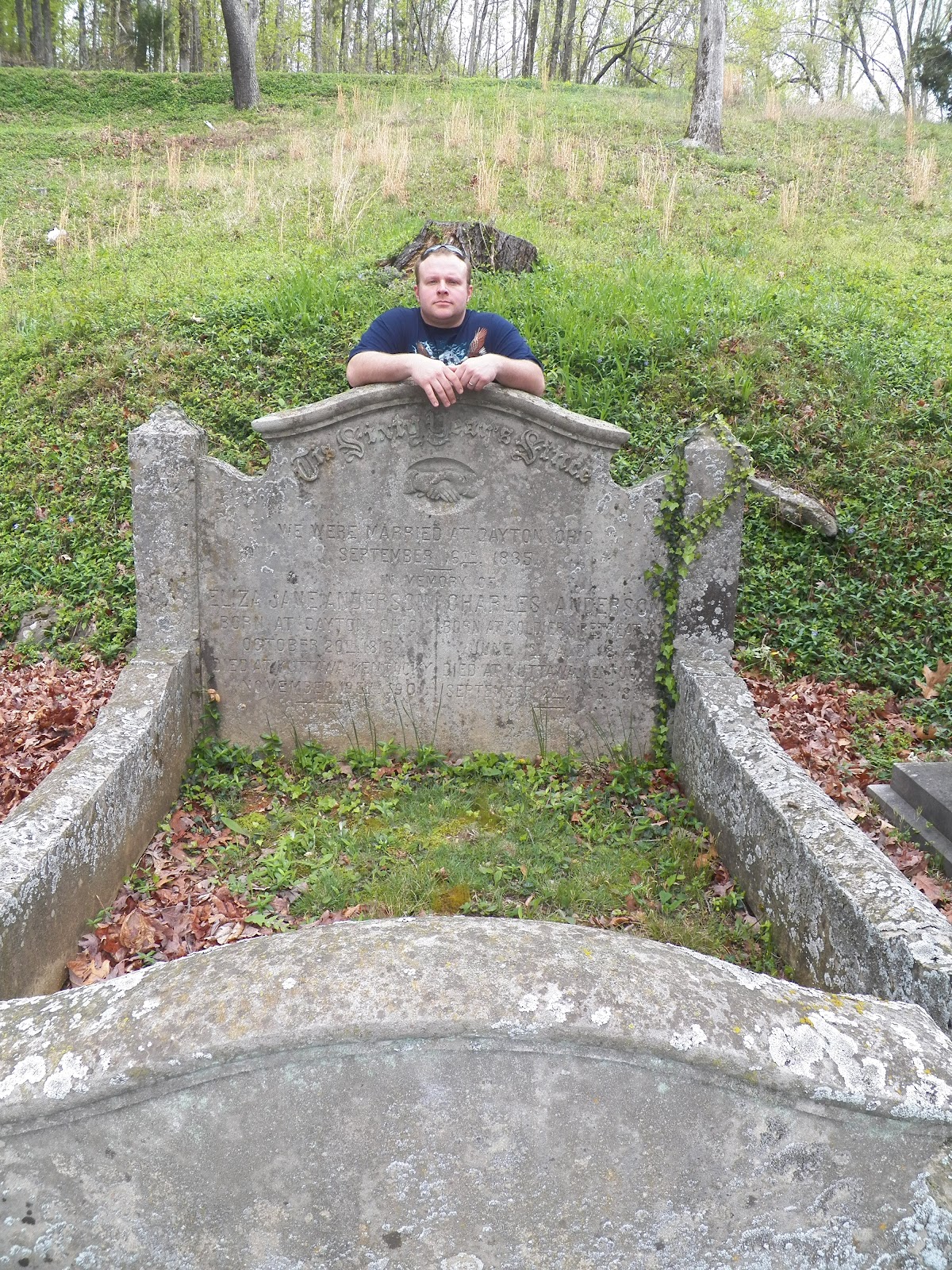
I visited the gravesite of Governor Anderson in March 2012. It worked out well that I was traveling through the area on my way from Nashville to St. Louis. Anderson is one of 7 Governors of Ohio that are not buried in the state. Anderson was the first of 2 out of state Governor gravesites that I got to see on this trip.


Governor Anderson's gravesite is one of the most unique that I have seen. It's shaped like a bed frame.


Governor Anderson and I


Sunday, March 18, 2012

#18 Mordecai Bartley

Mordecai Bartley


Born: December 16, 1783
Died: October 10, 1870
Political Party: Whig
Term of Office: December 3, 1844 - December 12, 1846
Buried: Mansfield Cemetery Mansfield, Ohio
23 of 56


   Mordecai Bartley was born in Fayette County, Pennsylvania in 1783 to a farming family. He married in 1804 and in 1809 moved his young family to Jefferson County, Ohio.

    When the War of 1812 broke out, Bartley served as a Captain on an infantry company that he, himself started. Eventually General William Henry Harrison appointed him adjutant of one of his regiments. After the war, Bartley moved his family to a new farm near Mansfield, Ohio. Due to the families involvement in merchant activities, on top of farming, the family moved into the town of Mansfield to be closer to the action in 1834.

    While Bartley was doing well with his farm and other business ventures, he got involved in politics. He served as a state senator in 1817 and 1818. Then in 1822, he was first elected to the U.S. House of Representatives. He served 4-2 year terms in Congress and then decided to retire from politics and not seek reelection in 1830. He went home to Mansfield and tended to his business ventures.

   In 1844, Mordecai Bartley's son, Thomas, was serving as Speaker of the Ohio Senate. When Governor Wilson Shannon resigned to become President John Tyler's minister to Mexico, Thomas Bartley became the 17th Governor of Ohio, place holding the office for the rest of Shannon's term. 1844 was an election year, and the Whig party approached Mordecai Bartley to be their candidate for Governor of Ohio. He accepted, beating his Democratic challenger and future Governor David Tod. And so, on December 3, 1844, Mordecai Bartley was sworn in as Ohio's 18th Governor, succeeding his son Thomas as Governor. This is one of the very few times that a father succeeded his son to such a high political office.

    Mordecai Bartley's single 2 year term as Governor was busy. With Whig's controlling the state legislature they were able to accomplish a lot. They passed the Kelly Key Bank Bill of 1845, which stabilized the state banking system. He was also well known for his opposition to the fugitive slave laws and Ohio's laws limiting basic rights to African American's. He also opposed the Mexican War, but did his part to round up troops for the war effort. Bartley did not seek reelection and retired from politics for good, once again attending to his business ventures in Mansfield. He died in 1870.
 

    I visited the gravesite of Governor Mordecai Bartley on March 4, 2012, a Sunday afternoon. We had just done our northern KY / Cincinatti trip the Sunday before. In that week we had gotten our new camera in the mail. We had been very disappointed with the picture quality of our old camera for awhile now. And I was very disappointed with how some of the pictures turned out from the previous week. I really wanted to go somewhere to try out the new camera. Mansfield is only about an hour or so away and I knew that there was a Governor buried there. So after church we headed for Mansfield for a little site seeing. Mansfield is also the area where most of the movie 'Shawshank Redemption' was filmed. I didn't look to much into it. But I did map out the Ohio State Reformatory ( aka Shawshank prison) to see while we were in the area. As it turns out the prison was closed til May. But I found a website that gives more filming locations for the movie in the area. So sometime I will make it over there and see all that. Mordecai Bartley's grave wasn't to hard to find, since I knew from findagrave that he just across from the large John Sherman gravesite.

Mordecai Bartley gravesite Mansfield, Ohio


Governor Modecai Bartley and I. Mansfield, Ohio


BloggerImage
The next few pictures are from my return trip in June 2017


BloggerImage


BloggerImage
My kids Governor Bartley and I

#51 Myers Y. Cooper

Myers Y. Cooper


Born: November 25, 1873
Died: December 5, 1958
Political Party: Republican
Term of Office: January 14, 1929 - January 12, 1931
Buried: Spring Grove Cemetery Cincinnati, Ohio
22 of 56

   Myers Y. Cooper was born in St. Louisville, Ohio in 1873. After attending 2 years of college, he left without graduating. In 1896, he moved to Cincinnati and opened up a real estate business. After a great deal of success in the real estate business, he opened up other companies in lumber and banking. Over time he would also serve as president of Ohio Fair Managers Association and president of the Ohio Council of Churches. In real estate he became known for allowing people to by houses on credit it they were unable to pay for the whole thing upfront.

   Cooper was active in Ohio Republican politics throughout the 1910's and 20's, holding mostly party positions. The first political office that he ran for was Governor of Ohio in 1926. He lost to the incumbent Governor Alvin Victor Donahey. He ran again in 1928 and was swept into office along with a Republican sweep across the country. His defeated Democratic opponent, Martin L. Davey, would go on to be Governor himself a few years down the road. Herbert Hoover was elected President that year, and the Ohio general assembly was predominantly Republican, allowing Cooper to get a lot of his plans through to law. 

    Cooper had the unfortunate luck of being Governor when the Great Depression hit. The people felt that Cooper should of done more to help their troubles. And so, he lost reelection in 1930 in George White. After loosing reelection, Cooper returned home to Cincinnati to his many business ventures. His name is still associated with real estate. When I googled his name in research, I found several links connected to a real estate company before I came to any information on the man himself. He died in 1958.

       Myers Y. Cooper was the 6th and final Governor grave that we visited in Spring Grove Cemetery in February 2012. 9 Governors total are in Spring Grove. I had gotten 3 when I stopped by in September 2011. So it took me 2 trips but I finally got all 9.
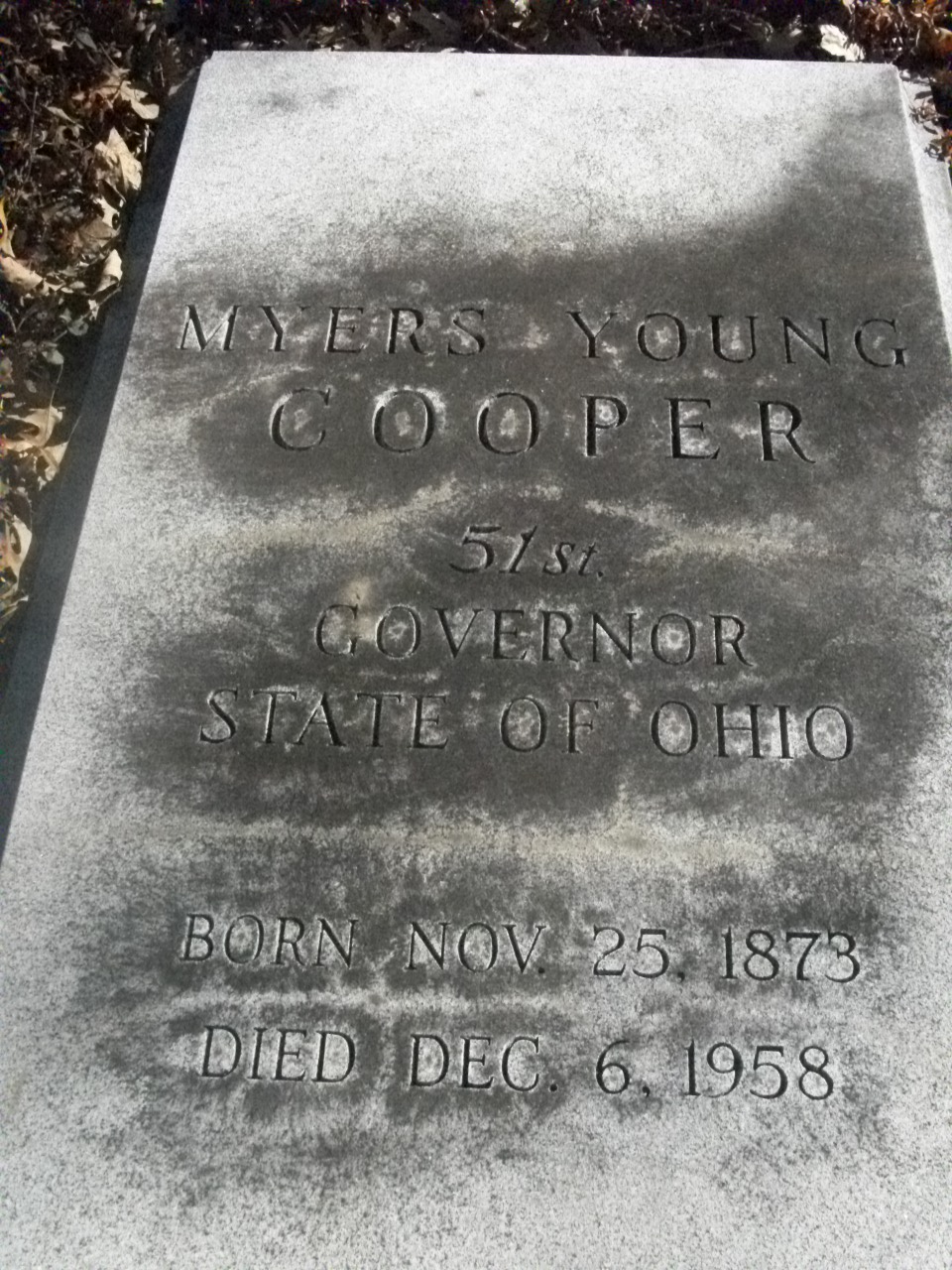
      Most of the Governor graves that I have seen make no mention of them serving as Governor. Coopers grave was different. He and/ or his family must of been very proud of the fact that he served as Governor as you will see. I liked it!


Governor Cooper gravesite. The personalized white slabs remind me of Harry Truman's gravesite

Myers Y. Coopers personal gravemarker


Governor Cooper and I


BloggerImage
Picture taken during April 2017 revisit, during a storm


BloggerImage
Governor Cooper and I. I'm getting very wet and this point.

#37 Joseph B. Foraker

BloggerImage
Joseph B. Foraker


Born: July 5 1846
Died: May 10, 1917
Political Party: Republican
Term of Office: January 14, 1886 - January 12, 1890
Buried: Spring Grove Cemetery Cincinnati, Ohio
21 of 56

     Joseph Foraker was born in Highland County, Ohio in 1846 to a farming family. When Foraker was 15 he went to stay with an Uncle who worked as a County auditor. Having little previous schooling, this gave him the chance to learn more as he clerked for his Uncle.  At the age of 16 he joined the Union Army eventually earning the rank of Captain. He served under General William Tecumseh Sherman during his March to the Sea.

   After the war, Foraker attended Ohio Wesleyan University before going to study law at Cornell University. Foraker graduated from law school at Cornell in 1869, which also happened to be Cornell's first graduating class of 8 total students. He was admitted to the Ohio bar in October 1869, after moving to Cincinnati and started practicing law.

   Foraker became a successful lawyer, gaining a reputation as a well spoken Republican. In 1879, he entered politics by being elected as a judge on Cincinnati's superior court. In 1883, Foraker was chosen as the Republican candidate for Governor of Ohio. But after Republican Governor Charles Foster raised taxes on liquor, it really hurt any Republicans chance of winning the election. Foraker lost in 1883 to Democrat George Hoadly.

    Foraker was chosen as an at large delegate to the Republican National Convention in 1884 along with Congressman and future President William McKinley and Cleveland political boss Mark Hanna. Foraker was persuaded to nominate Senator John Sherman (brother of General William Tecumseh Sherman) from Ohio for President. Sherman ultimately lost the nomination to James G. Blaine. But his involvement in the Convention gave him national recognition. He was even considered as a VP Candidate for Blaine, receiving one delegates vote. Having become a more familiar face and name, he ran again in 1885, beating Hoadly this time.

   As Governor, Foraker worked to end voter fraud, worked to end corruption at the city level of government, created a state board of health, and pushed for greater oversite on the management of the state prisons, among many other things. He won reelection in 1887.

   In 1887, President Cleveland asked that all southern battle flags captured by the north during the Civil War be returned to the south. Foraker refused, saying that it wasn't going to happen while he was Governor. Foraker was hailed a hero by many for his refusing the President's request, receiving thousands of congratulatory messages. Not long after, Foraker visited Philadelphia to celebrate the 100th birthday of the Constitution. In one of the parades, Foraker rode past President Cleveland as he and other Civil War Veterans waved some of the south's captured battle flags that Cleveland asked be returned.

    A split occurred in the Ohio Republican party during Foraker's 2nd term when he refused Mark Hanna's recommendation for who should serve as Ohio's state oil inspector. By splitting with the Hanna, McKinley, Sherman wing of the party, Foraker lost reelection to a 3rd term in 1889. Mark Hanna played a big part in James A. Garfield's successful 1880 Presidential Campaign, and it seemed that Foraker was being groomed for a future Presidential run. But after the split with Hanna, Hanna seemed to focus his attention on making William McKinley President some day. Which he did.

    Foraker returned to practice law in Cincinnati. He began to heal the wounds of the split when in 1891, he agreed to William McKinley's request to put forward his name at the state Republican convention for Governor of Ohio. But things heated up again when Foraker unsuccessfully tried to take the Republican nomination for Senator away from John Sherman in the election of 1892. But later that year, Hanna and Foraker made peace when Foraker agreed to Hanna's request to put William McKinley's name in nomination for President at the 1892 Republican National Convention. McKinley lost the nomination to President Benjamin Harrison and James G. Blaine. But 4 years later, McKinley won the nomination and the White House.

    Foraker's influence in Ohio Republican politics reached a peak in the Republican state convention in 1895. Foraker chose an ally, Asa Bushnell to be candidate for Governor, and positioned himself as candidate for the U.S. Senate. Both Bushnell and Foraker won the offices that they were seeking. Foraker once again put McKinley's name up for nomination at the Republican National Convention in 1896. He also gave the nominating speech for McKinley. On March 4, 1897, Joseph Foraker took his seat as a US Senator. It was also the same day that McKinley became President. 

    Joseph Foraker served 2- 6 year terms in the Senate. In that time, he was a useful ally to his once rival President McKinley. But when Theodore Roosevelt became President he would often find himself at odds with some of his policies. Foraker would try for the Republican nomination for President in 1908, but was soundly defeated by Theodore Roosevelt's heir apparent William Howard Taft.

      In his first term as Senator, Foraker was given money in exchange for offering legal advice to Standard Oil. This sort of thing was fairly common back then. But the "conflict of interest" factor was just starting to become an issue. This became public knowledge around the time that he was running for a 3rd term in the Senate. He lost the election and returned to practicing law in Cincinnati. He took another shot at the Senate in 1914, but lost to future President Warren G. Harding. Foraker died  in Cincinnati in 1917.


Joseph Foraker was the 5th Governor grave we found in Spring Grove Cemetery in February 2012.  


BloggerImage
Captain Joseph Foraker during the Civil War


BloggerImage


Foraker gravesite


Governor Forakers personal gravemarker

Governor Foraker and I


BloggerImage
Picture taken during April 2017 revisit during a storm


BloggerImage


BloggerImage


BloggerImage
Governor Foraker and I. I'm getting very wet at this point.